Nicaragua and Costa Rica share a border, a Pacific coastline and a dry season, but they’re very different trips. Costa Rica is the easy, polished, well-connected option, and you pay for it. Nicaragua is cheaper, quieter and more raw, with a few extra risks and a bit more planning.
Full disclosure: we’re a vacation rental and trip-planning team based in Tola, Nicaragua, so we obviously love it here. We’ve tried to keep this fair, and we say clearly where Costa Rica comes out ahead. Everything below was checked in September 2026. Travel advice and entry rules change, so check the official links before you book. We’re also part of the same local group as Nicaragua Surf Camp, Magnific Rock, Esc – Digital Nomad Village and Emerald Real Estate, so we link to them where they’re relevant.
The quick answer
Choose Costa Rica if you want the most flight options, the lowest US travel advisory level, organised national parks, big family resorts and top private hospitals, and you’re fine paying noticeably more for everything.
Choose Nicaragua if you want a lower-cost trip, emptier beaches and surf, colonial cities like Granada and León, and a volcano where you can see the lava lake, and you’re comfortable with a higher US advisory level, fewer flights and more basic healthcare outside Managua.
You can also do both in one trip. We explain how further down.
Nicaragua vs Costa Rica at a glance
| Nicaragua | Costa Rica | |
|---|---|---|
| US travel advisory | Level 3: Reconsider travel | Level 2: Exercise increased caution |
| Canada travel advice | High degree of caution | High degree of caution |
| Visa for US, Canadian and UK tourists | No visa per government advice; $10 tourist card; up to 90 days | No visa; up to 180 days |
| Nonstop flights from the US | A few (Miami, Houston) | Around 34 a day |
| Average daily travel cost per person | About $65 | About $152 |
| International visitors in 2025 | About 1.1 million | About 2.9 million |
| Dry season (Pacific side) | December to April | December to April |
| Internationally accredited hospitals | One, in Managua | Several, mainly in San José |
| Currency | Córdoba (fixed at 36.62 per US dollar in 2026) | Colón (about 450 per US dollar) |
Sources: US State Department, Global Affairs Canada, Budget Your Trip 2026 rankings, INTUR, Costa Rica’s tourism board figures via La Nación, and the central banks of both countries.
Safety: is Nicaragua safer than Costa Rica?
Not according to the official ratings. The US State Department rates Nicaragua at Level 3 (reissued May 2026) and Costa Rica at Level 2 (April 2026). Canada gives both countries the same rating, “exercise a high degree of caution”, and updated both pages on 9 September 2026. The risks are different in each country.
Nicaragua’s main risks
- Arbitrary enforcement. The US warns Nicaragua has denied entry to, or expelled, some US citizens. Authorities may search phones and social media for anti-government content.
- Rules visitors don’t expect. Drones are banned, photographing police or government buildings is restricted, and foreigners can’t take part in political activity. Keep political opinions off your phone and your social media while you’re there.
- Everyday crime. Pickpocketing and bag snatching happen in tourist areas. Use registered taxis and don’t drive outside towns after dark.
- Nicaragua doesn’t publish trustworthy homicide figures, so be wary of anyone claiming it’s “the safest country in Central America” on the numbers. That being said, most people leave the country with that view.
Costa Rica’s main risks
- Theft. Canada calls passport theft “extremely common”. The US warns about robberies at short-term rentals and thieves using signal blockers on parked cars.
- Violent crime. Costa Rica’s homicide rate was 16.8 per 100,000 people in 2025, according to InSight Crime, and Canada links much of the violent crime to drug trafficking.
Our take: from where we sit in Tola, day-to-day life in the quiet beach areas where families stay, like Tola, Popoyo and San Juan del Sur, is relaxed. But the US Level 3 rating is there for real reasons, mostly political, and you should read it before deciding. If anyone in your family has Nicaraguan nationality, or you’re outspoken about politics online, read the advisories especially closely.
Entry requirements
- Costa Rica: US, Canadian and UK tourists don’t need a visa and can usually stay up to 180 days. You’ll need an onward or return ticket, and your passport must be valid for your stay.
- Nicaragua: US, Canadian and UK passport holders don’t need a visa. You buy a $10 tourist card in cash when you land and can stay up to 90 days. Your passport should be valid for at least six months, and you’ll need an onward ticket. Nicaragua changed its visa list in February 2026, but these three countries stayed visa-free, which their governments confirmed again in mid-2026. Crossing by land at Peñas Blancas costs about $13 to $14 once border and municipal fees are added.
- Travelling with kids: the US advises carrying a copy of each child’s birth certificate. Nicaragua tightened its exit-permit rules for minors in July 2026, but they’re aimed at Nicaraguan and dual-national children and those who live there. Costa Rica has similar rules for Costa Rican children. If your child holds either nationality, or you’re travelling with only one parent, check with the embassy well before you go.
Getting there
This is Costa Rica’s biggest advantage. It has around 34 nonstop flights a day from the US, year-round flights from Canada to Liberia, and two international airports (San José and Liberia) with dozens of routes.
Nicaragua has one main international airport, Managua (MGA), with nonstops from Miami (American and Avianca) and Houston (United). WestJet has run a seasonal Montreal flight in winter. There are no nonstops from Toronto, and Spirit Airlines, which used to fly from Fort Lauderdale, shut down in May 2026.
Fares are closer than you’d think. Kayak’s 12-month average round trip from the US was about $550 to Managua and about $626 to Liberia in August and September 2026.
A useful trick: Nicaragua’s southern coast is close to the Costa Rica border. Some visitors fly into Liberia and cross at Peñas Blancas instead. It takes longer, but it opens up far more flights. Our San Juan del Sur guide explains the border crossing, and our Popoyo guide covers the drive to the Emerald Coast.
Costs: is Nicaragua cheaper than Costa Rica?
Yes, for most things. Numbeo’s comparison puts Costa Rica’s consumer prices about 57% higher than Nicaragua’s, and restaurant prices about 86% higher. Budget Your Trip’s 2026 ranking puts the average traveller’s daily spend at about $65 in Nicaragua and $152 in Costa Rica.
| Typical price (USD) | Nicaragua | Costa Rica |
|---|---|---|
| Inexpensive restaurant meal | $5 | $11 |
| Mid-range dinner for two | $33 | $56 |
| Local beer at a restaurant | $1.40 | $3.30 |
| Mid-range beach hotel, average night | $81 (San Juan del Sur) | $156 (Tamarindo) |
| Vacation rental, average night | $277 (Tola), $200 (San Juan del Sur) | $395 (Tamarindo), $429 (Nosara) |
| 2-hour group surf lesson | About $35 | From about $56 |
| Zip-line tour, adult | About $29 (Mombacho) | About $72 (Monteverde) |
| National park entry, adult | $4 by day, $10 at night (Masaya Volcano) | $15 plus tax at most major parks |
Sources: Numbeo (July to September 2026), Budget Your Trip, AirROI (rental data to August 2026) and operators’ published prices. Averages hide a lot of range.
Where the gap is smaller: high-end villas. Big homes with pools in Tola aren’t a bargain compared with parts of Guanacaste. The real savings in Nicaragua are on food, drinks, tours, transport and mid-range hotels. Also note that Costa Rica adds 13% tax to hotels and tours, and restaurants add 13% tax plus a 10% service charge, so menu prices can be misleading.
Thinking about a longer stay? Our sister company ESC breaks down the cost of living in Nicaragua as a remote worker, including how it compares with Costa Rica.
Crowds
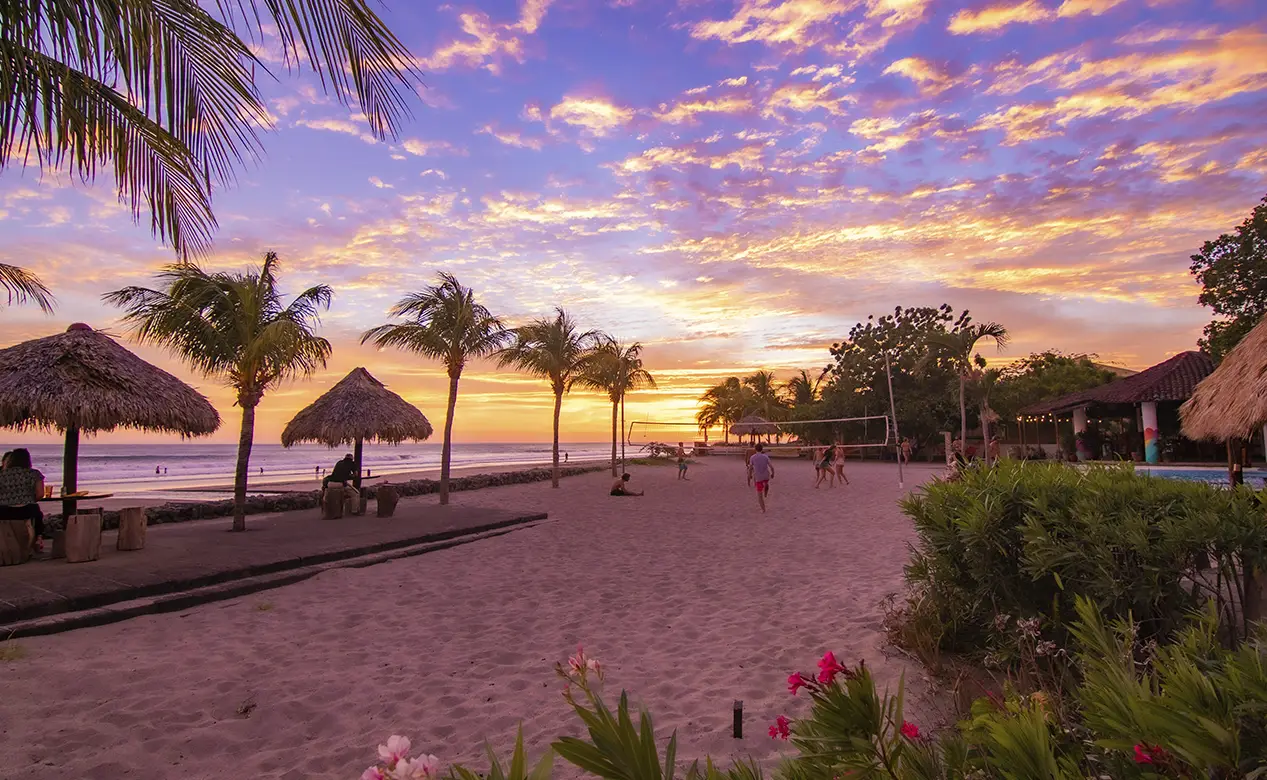
Costa Rica had about 2.9 million international visitors in 2025. Nicaragua had about 1.1 million, and many of those came overland from neighbouring countries. You feel the difference on the beach and in the water. Tamarindo, Santa Teresa and Manuel Antonio get busy in high season. Nicaragua’s surf towns, like Popoyo and Playa Gigante, and quieter beaches like Marsella near San Juan del Sur, are far less developed.
Beaches and surf for families
Both countries have excellent Pacific beaches and very few lifeguards, so pick calm beaches for young kids in either place.
- Calm family beaches in Costa Rica: Sámara, Playa Hermosa (Guanacaste), Playa Conchal and Biesanz near Manuel Antonio.
- Calm family beaches in Nicaragua: the San Juan del Sur town bay, Playa Marsella, Playa El Coco and Playa Los Perros at Rancho Santana.
- Learning to surf in Costa Rica: Tamarindo and Playa Guiones in Nosara have gentle, consistent beach breaks and lots of surf schools, some taking kids from a very young age. The trade-off is crowds.
- Learning to surf in Nicaragua: Popoyo, Playa Gigante and Playa El Remanso have beginner waves and far fewer people, and lessons cost less. Popoyo’s Beginners Bay is a sheltered wave made for learning, and Nicaragua Surf Camp runs surf packages right on it.
You’ll often hear that southern Nicaragua has “300 days of offshore winds”. That’s a surf-industry claim rather than a scientific figure, but the wind that funnels across Lake Nicaragua really does groom the waves on this coast for much of the year. Northern Guanacaste gets the same wind, which can make the dry season choppy and breezy for little ones.
Planning a beach trip in Nicaragua? See our Popoyo and Tola travel guide, our San Juan del Sur beach guide, or browse vacation rentals in Tola, including Popoyo beach houses and Rancho Santana villas.
Nature, wildlife and culture
- Wildlife and parks: Costa Rica wins. It holds about 6% of the world’s biodiversity, around a quarter of the country is protected, and the park system is well organised with online tickets and set hours. Monteverde, Arenal, Manuel Antonio and Tortuguero are world-famous for a reason. Nicaragua’s biggest wild areas, like Indio Maíz, are remote and hard to visit.
- Volcanoes: Nicaragua has the edge for drama. At Masaya Volcano you can drive to the rim, and lava has been visible again since mid-2025, although how much you see varies from night to night. Costa Rica’s Arenal is beautiful but hasn’t had a significant eruption since 2010. Older kids and teens can also go volcano boarding at Cerro Negro, near León.
- Sea turtles: both are great. Nicaragua has mass nesting at La Flor near San Juan del Sur, roughly July to January. Costa Rica has Ostional (peak September and October) and Tortuguero (green turtles July to October).
- Colonial cities: Nicaragua wins easily. Granada and León are colourful colonial cities full of history, and León Cathedral is a UNESCO World Heritage Site. Costa Rica has very little colonial architecture.
- Adventure: Costa Rica has more polished options, like big zip-line parks and family whitewater rafting. Nicaragua’s adventures are cheaper and simpler, like zip-lining on Mombacho Volcano, exploring Ometepe Island or joining a yoga retreat at Magnific Rock above Popoyo’s Beginners Bay.
Healthcare
This is an important one for families, and Costa Rica is clearly ahead.
- Costa Rica has several internationally accredited private hospitals in San José, including CIMA, and a 24-hour private hospital in Liberia, Hospital San Rafael Arcángel. Public hospitals are good but can have long waits. One tip: CIMA’s Guanacaste hospital closed in 2018, even though some websites still list it.
- Nicaragua has one internationally accredited hospital, in Managua. The US says clinics outside the capital often lack basic resources. On the southern coast, you’re about 2 to 3 hours from Managua, so serious cases may need a transfer or evacuation.
In both countries, don’t drink the tap water, use mosquito repellent (dengue and Zika are present in both, and Nicaragua had a chikungunya outbreak in 2026), and buy travel insurance that covers medical evacuation.
Getting around
- Roads: both have potholes, narrow roads and poor lighting, and both governments advise against driving at night. Road death rates are similar.
- Driving and rental cars: Costa Rican rental cars can’t cross into Nicaragua. In Nicaragua, a driver involved in a crash with injuries can be detained, whoever was at fault, so a private driver is often the simpler choice.
- Internet: Costa Rica’s mobile internet is the fastest in Central America. Nicaragua’s is slower, so if you need to work, ask about the connection before you book a house, or work from the ESC coworking space in Popoyo, which has backup power.
- Money: US dollars work in tourist areas of both countries, and cards are usually accepted. ATMs can be hard to find outside Nicaragua’s main towns, so carry some cash.
When to go
The Pacific side of both countries is dry from December to April, which is also peak season and peak prices. The rainy “green season” runs from about May to November. Nicaragua usually gets a drier spell in July and August, called the canícula.
Book early for Christmas and New Year, Easter week (Semana Santa, 21 to 28 March 2027) and July, when local schools in both countries are on holiday.
Can you visit Nicaragua and Costa Rica in one trip?
Yes, and it’s a great way to get the best of both. A typical 10 to 14-day family route looks like this:
- Fly into Liberia, Costa Rica.
- Spend 3 to 5 nights in Guanacaste or around Arenal.
- Transfer to the Peñas Blancas border (about 1.5 hours from Liberia) and cross on foot. Allow 1 to 3 hours.
- Spend 4 to 5 nights on Nicaragua’s southern coast, in San Juan del Sur or Tola.
- Spend 2 to 3 nights in Granada, with a trip to Masaya Volcano.
- Fly home from Managua, or head back to Liberia.
Border fees add up to roughly $25 per person for the round trip, and you’ll need transport arranged on each side. Leave the Costa Rican rental car on the Costa Rican side.
Nicaragua vs Costa Rica FAQ
Is Nicaragua cheaper than Costa Rica?
Yes. Food, drinks, tours and mid-range hotels cost noticeably less, and a cheap restaurant meal is about half the price. The gap is much smaller for luxury villas.
Is Nicaragua safe for families?
Day to day, Nicaragua’s quiet beach areas are relaxed, but the US rates the country Level 3 (Reconsider travel), mainly because of arbitrary detention and political risks. Canada rates Nicaragua and Costa Rica the same. Read both advisories and decide what you’re comfortable with.
Which has better beaches?
Both have beautiful Pacific beaches. Costa Rica has more developed beach towns and resorts. Nicaragua’s beaches are quieter and less built up, especially around Tola and Popoyo.
Which is better for learning to surf?
Both are excellent. Costa Rica has more surf schools and gentle beach breaks but bigger crowds. Nicaragua has fewer people in the water, frequent offshore winds and cheaper lessons.
Do I need a visa for Nicaragua or Costa Rica?
US, Canadian and UK tourists don’t need a visa for Costa Rica, and their governments say they don’t need one for Nicaragua either, just a $10 tourist card on arrival. Rules can change, so check with your airline before you travel.
Are there direct flights to Nicaragua?
Yes, but only a few, mainly from Miami and Houston. Some visitors fly into Liberia, Costa Rica, and cross the land border instead.
Our take
If it’s your family’s first big trip abroad, you need lots of flight options or you want everything polished and predictable, Costa Rica is the safer bet. If you’ve travelled a bit, want more space and more for your money, and like the idea of colonial Granada and uncrowded surf, Nicaragua is worth a serious look. And if you can’t decide, do both.
If you fall for Nicaragua the way many visitors do, our sister company Emerald Real Estate can show you property in Tola and Popoyo and walk you through buying property in Nicaragua.
Thinking about Nicaragua? Tell us your dates and who’s coming and we’ll put together homes, transfers and tours that fit your family, or WhatsApp us at +505 8916 6916.